
FROM ROB'S BENCH
Calling all mitre saw stations!

Rob Brown
Blog for March 5, 2026
A good friend of mine just moved into a new house that has space for a small workshop.
He’s made many small- to medium-sized woodworking projects over the years, and is really looking forward to having a better space to set up a shop in. To show you have far we go back, we were both in the woodshop class back in high school.
One of his first shop projects is going to be a mitre saw station. His initial thought is that it could be on wheels, as it might be beneficial to be able to move it around while working. It’s a smaller space, so having things on wheels is sometimes very handy. He was also considering a collapsible wing on either side of the saw that could support a workpiece he was cutting. I’m thinking this would work nicely for short- to medium-length pieces, but long pieces could cause the entire cart to topple over, if the workpiece extended too far off one end of the station.
Although I know they’re very common, I don’t think I’ve ever worked on a mitre saw station that was mobile. I picture it moving around while cutting, though even worse would be the fact that it could be slightly top-heavy and might even tip over if the wheels got caught on a chip of wood as you were pushing it backwards. Obviously, a big factor in whether it will tip over or not is how large the footprint is.
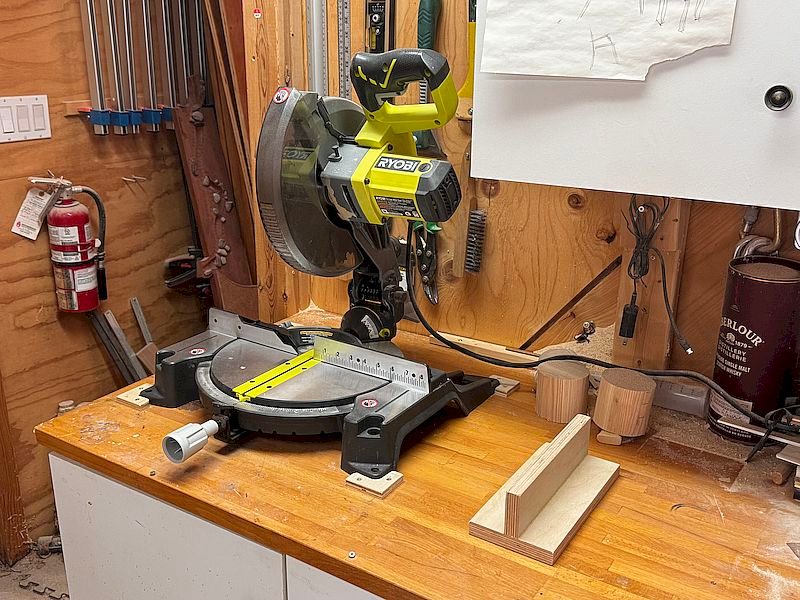
I challenge you to find a mitre saw station that’s simpler than my current setup. I have a set of lower cabinets with a solid wood counter top. On top of the countertop sits the mitre saw. Four small plywood brackets keep the mitre saw from moving, though still allow me to lift the saw up, pop it in my vehicle and take it to the jobsite whenever is needed. The only accessory I use is a very simple T-stand to support long workpieces
It works well for most of my cuts, though I have been meaning to fancy it up a bit. I would like to add some sort of a stationary horizontal surface to support workpieces, while also having a back piece on it so I could set a stop for multiple cuts of the same length. It would still be nothing too fancy, but would give me pretty much all I need.
I used to have a slightly fancier setup that included a horizontal surface to support workpieces and a vertical face with a moveable and lockable stop on it. It even had a tape measure inset into the back edge, so I could quickly setup the stop to give me the cut length I needed.
Any ideas?
I’d love to see your mitre saw station. I’d also like to hear what you like more about it, not to mention what you dislike about it. And finally, if you were going to build another mitre saw station, what sort of approach would you take? Stationary vs a rolling cart? Would you incorporate a sliding stop in it? Maybe you’d set your saw on a rotating surface, with another shop tool on the other side of it, so you could flip whatever machine you were going to use to the upper side. Would you do anything to deal with dust collection? Email me a photo or two, along with a few sentences about your setup. I’m hoping to build a nice, yet simple, setup for my friend, though we don’t want to take forever to build it. There are too many interior projects for us to tackle first.
My Setup
My mitre saw sits on top of my countertop. As long as I keep the countertop surface clean, it works pretty well. Having said that, I should keep that surface tidier.
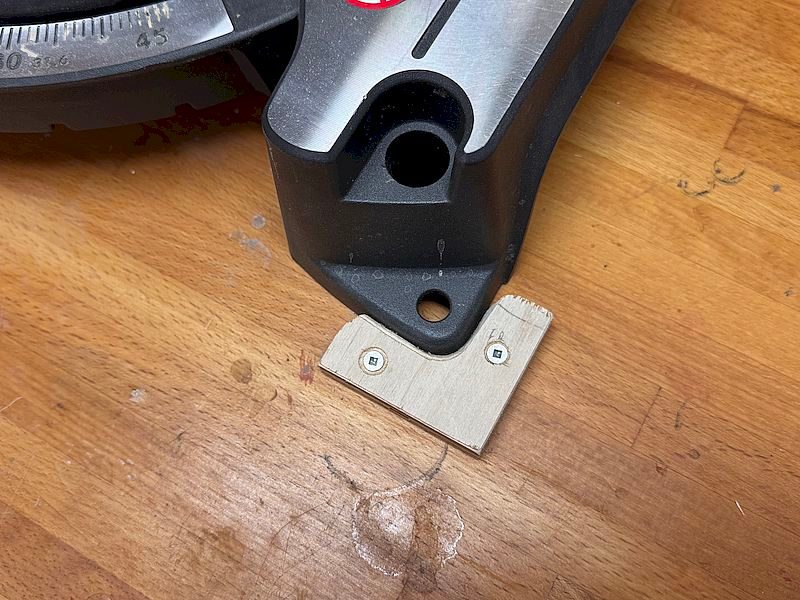
Plywood Brackets
The plywood brackets keep the saw from moving and allow me to easily pick the mitre saw up to move it, then put it back, right where it was when I'm done.
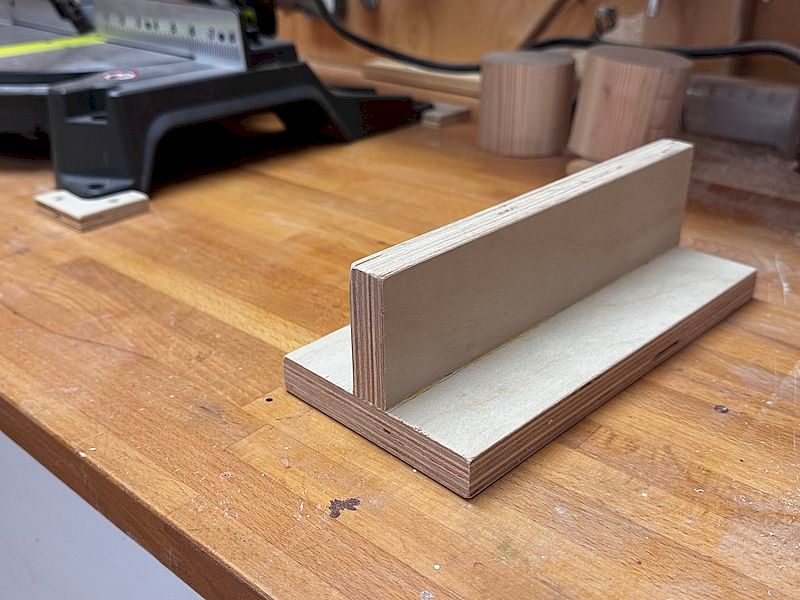
Simple Support
It's nothing fancy, but it's made to be the same height off the countertop surface as the top of my saw, so it does the trick just fine.



I use a “RIDGID Foldable Mobile Miter Saw Stand with Mounting Braces” I bought at Home Depot, as I have to store it (folded up) in my garage when I am not using it. It is heavy with the saw installed, but has large wheels, so it is fairly easy to move around. It’s a solution if you don’t have a permanent place to install it.
Write about dust collection on a miter saw. Now, that’s what we need and not the article you just wrote.
I built my motor station on a moving platform, housing to metal office drawer cabinets cabinets. Then I built a three ply surface with a half inch steel rod in the middle of the three ply surface. The ends of the rod spin on ball bearing mounts on the side of the cabinets. I can flip this set up so that I have a miter saw on one side and a Rigid spindle/belt sander on the other. But because it has to swim/spin to access one tool over the other, dust collection has been a difficult quest. Now, if you could suggest something, that would be appreciated..
same type of set up but on a shelf that lifts up, using a pully along a couple of tracks to match the bottom of your upper cabinet. when lowered it goes into a couple of tee tracks so I can side it along the bench top and a lock toggle to keep it put
My mitre saw just sits on a bench as well so I am looking forward to seeing what idea’s are presented.
I like the simple wood brackets to hold the saw in place.
I’ve never considered a mitre saw a shop tool, for me it’s more of an outdoor/job site saw. My mitre saw hibernates in the shed until called for infrequent use or to loan to a neighbour.
For myself the mitre saw is often used to break down rough hardwood, although that’s more often accomplished with a worm drive Skilsaw.
I have a small basement shop, a mitre saw for me is a waste of space with awful dust collection capabilities.
I have a Hammer B3 saw/shaper, compact, good dust extraction and far higher capacities than a mitre saw.
I’ll be interested in reading the comments, always a good opportunity to see and learn new things.