
FROM ROB'S BENCH
Deep into the cracks

Rob Brown
Blog for May 7, 2026
I love the warmer weather, though I could live without all the outdoor chores that come with rising temperatures.
Weeding, repainting fences and gates, mowing the lawn, and cleaning bird droppings off my car windshield aren’t my idea of a good time. Spring is the official start to these sorts of odd jobs.
We hired a company for a large landscaping project on the front of our home a few years ago. Part of that project was to add some 1×6 treated wood on top of the 4′ deep by 10′ wide front porch and complete it with stairs and siding. It’s only about four years old, but it’s already showing signs of age. The north-facing porch doesn’t get a lot of direct sunlight, so it doesn’t dry out after a rain as fast as I’d like. And the neighbouring large maple trees block out any additional sun later in the day. It’s not all bad, as having a shaded front porch during a hot summer evening can be great.
The downside is moisture getting into the deck boards, accentuated by the fact that I never applied a finish to the wood. On top of that, the boards were placed very snuggly beside each other when the porch project was complete. I’m guessing this was because the boards were wet, and the carpenter anticipated the boards would shrink, creating too much of a gap between all the boards. But that never really happened. The boards shrank somewhat, but the gaps between the boards remain fairly tight.
I’m not an expert on this topic, but I always figured gaps in deck boards followed the Goldilocks principal, in that they shouldn’t be too wide or too narrow, but just right. A wide enough gap between boards allows debris to fall through the cracks without causing any other functional problems. This keeps the surface of the deck cleaner and allows water to better drain off the boards.
Packed gaps
The gaps in our porch deck were virtually all filled in tightly with a wonderful mixture of dirt, small rocks and dog hair, preventing water from draining off the upper surface of the deck quickly, and also holding excessive moisture between the deck boards.
At first, I thought a quick pass with a stiff broom would knock much of the debris free. I was very wrong. If anything, it added even more dirt to the already snug gaps. I decided to grab a butter knife to get between the gaps to dislodge the debris from between the boards. This sometimes worked well but generally speaking it was slow going. The dirt was packed in there tightly, but the main culprits were all of the small rocks wedged into the cracks. It wasn’t easy for a knife to simply lift them all out. Instead, I needed another object to act as a pivot point, so when I pressed the handle downward, the middle of the knife would pivot on the other object and the distant end of the knife would pry out the rocks and debris. A thin piece of wood worked well for this, and before long I was back in business.
Still, progress was slow. There were many areas I couldn’t get into with both the knife and the thin piece of wood. Under the metal railing, tight against a mating step or close to the house were just a few of the problem areas. I was able to get some of the debris out, but far from all of it.
To the shop!
I realized I could likely spend the next hour on this small deck, but still not have removed all the debris. Thinking of some other tools or techniques that could assist me with this increasingly tricky and frustrating task, I considered using compressed air. A blast of 100 PSI air would surely help loosen and remove a fair bit of extra debris, especially if I could start the removal process with a butter knife.
Later that day I brought home my compressor and an air nozzle and got to work. It worked like a charm. A blast of air quickly and efficiently removed the vast majority of what was left after the knife. Within five minutes I was essentially done. I only had to revert to the butter knife a few times to pry out a few problematic rocks. It’s yet another case of having the right tools for the right job.
Next up, a finish
It’s been somewhat wet and cold here in Peterborough over the past few weeks, so I haven’t been able to apply a few coats of finish to the porch. I’ll most definitely get to it this summer, though. Having said that, I’ll admit I said the same thing last spring and never got around to it. A quick cleaning, then I’ll be able to apply a few coats of finish when the time comes.
I’m leaning towards a penetrating oil, rather than going with a film finish. Film finishes look fantastic for a year or two, then quickly go downhill, forcing you to scrape, sand and sweat your way through removing the finish before applying a few new layers. I’d rather not have to redo this porch every few years.
Have you had some success with a specific coating for an outdoor application? Any thoughts on a finish I could use? I’d love to hear your suggestions, so please add a comment here or send me an email.
Tight Fit
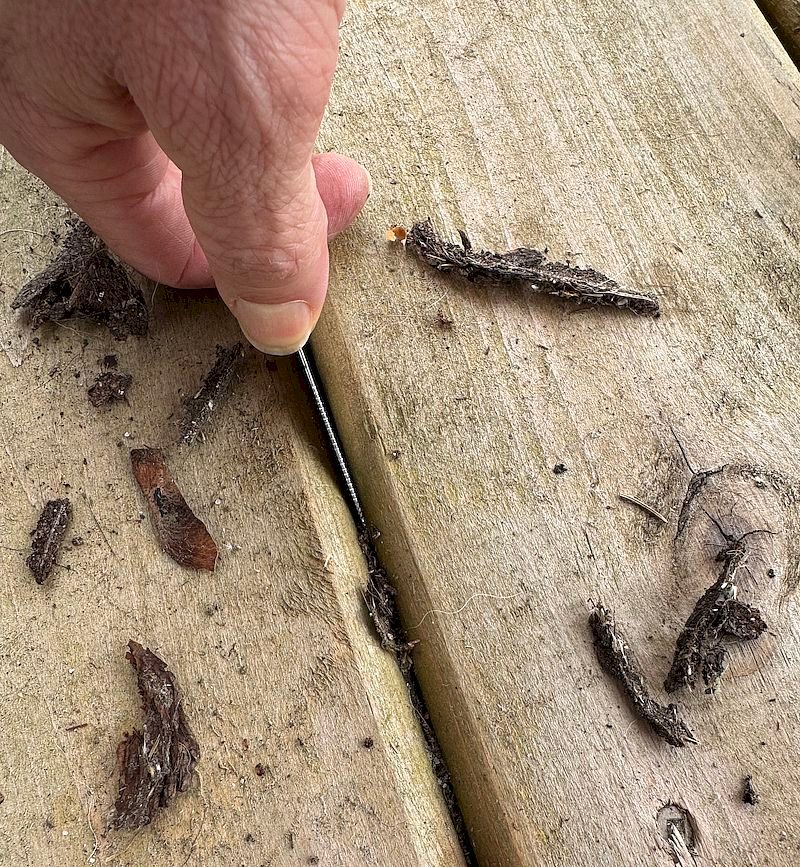
It was even difficult getting the butter knife to fit between a lot of these boards, let alone lift all the debris out of the gaps.
A Blast of Air
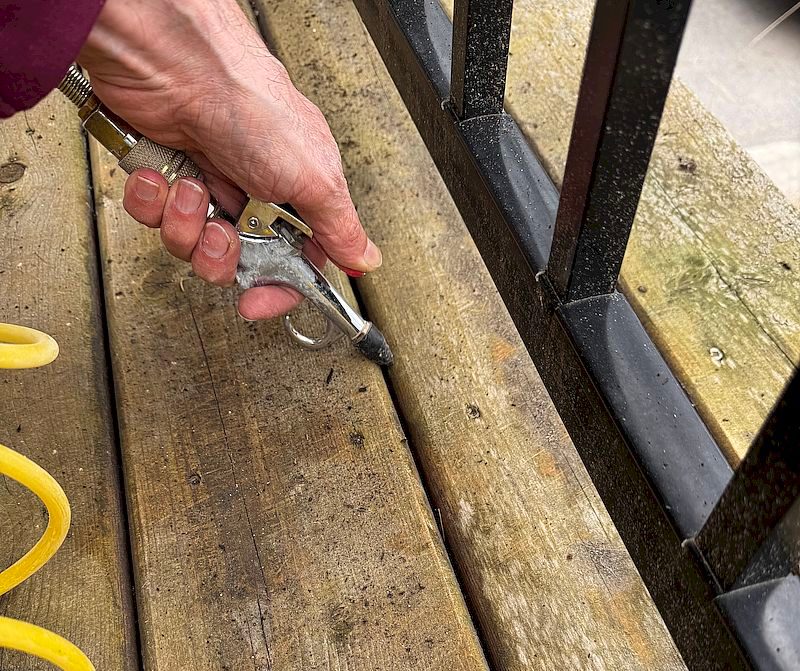
Compressed air quickly helped me got the vast majority of debris out of the gaps.
Watch in Real Time
This video shows how easily the compressed air cleared debris from the gap.


We have a similar problem. Lee Valley has a couple of Crack Weeders (Item PD405 – Telescoping Crack Weeder, Item AB662 – Lee Valley Mid-Length Crack Weeder) that work wonders. Probably the same as the tool that Norman described. They might save a butter knife. Not enjoying this job very much, I may try the idea of running a skil saw down the joint.
When I worked at a certain orange-themed home improvement store I tended to recommend the Behr brand of penetrating oil for exactly the reason you mention. If you want to add a bit of color it can be tinted to any of the same colors as the semi-transparent water-based deck finish (never buy this, horrible stuff). Never actually got to use it myself as I had no deck at the time and my current deck is not worth putting a clear finish on it.
Hi Rob
Also enjoyed your article. I do not have a deck. Only because I do not have the space.
I like the idea of an oil as it does not peal and easier to reapply.
Also I think a skill saw with 1/8th inch wide blade would leave the space to let the debris fall through. Obviously before the oil goes on.
Let us know what you end up doing.
What about running a jigsaw along each gap to widen it a touch?
Like the idea of using the air compressor. My decking has the same problem, boards didn’t shrink ( no gap). If put on a deck stain that was recommended, but it seems that I need to do this every few years also. I have asked around if I should put a coat or two of Thompson Water Stain over the deck paint.
Your thoughts?
There is an excellent device on the end of a 4-5 foot handle which was designed for removing debris and tree needles (eg. Pine needles) from between dock boards. It works well, effective, and I can clean between the deck boards of a large dock in minutes.
I wonder if you could run a saw along the gaps to widen them a bit? Even if you only cut between the support structure’s joists that should let the water drain and most of the debris fall through.
As for a finish, I never applied anything to the deck that came on our house and our neighbour religiously painted his with stain (the stuff that is more like paint than what you would use on furniture) every few years. His deck didn’t hold up as well as ours so I’d say all of that time & money was wasted. Needless to say, when I replaced the deck I didn’t paint it.
I don’t know whether an oil finish would hold up any better but at least it wouldn’t flake off like the film type stuff does.
As the deck boards did not shrink in width so that the gap between them was wider I think I would just unscrew the boards as the deck surface, 4’ x 10’ is small, and relay them with the desired gap. That way I’m be done with the issue of digging our debris between the boards. I make this comment based on being an older geezer and having building many fences and decks over the years.
Hi Rob. I enjoyed reading your article on cleaning the deck. It made me realize that my wife and I aren’t the only people who struggle to keep their deck looking nice.
An FYI for you. A few years ago we discovered a deck finish called Pentox. We buy ours at Home Hardware. After many years of trying various stain/finishes we are very, very, happy with this product. It penetrates and protects and doesn’t peel. Be sure to put it on when the wood is dry and it’s not too hot as it needs to penetrate into the wood. Best of luck. Kevin (Fenwick, Ontario)