
FROM ROB'S BENCH
I hate impact drivers

Rob Brown
Blog for April 9, 2026
Two weeks ago, I helped a good friend, a hobbyist woodworker, get settled in his new home.
I told him I would happily help him move boxes into his new place, but it might be more worthwhile for him if I helped him with something more along the lines of a small home reno, storage project or other woodworking project. A few weeks ago, I wrote about a potential mitre saw stand project, which gave me some great ideas. Although I passed those ideas onto him, and we may very well make that stand in the future, we decided to add shelving and hanging rods to the closets in the three bedrooms so everyone could make the most of the storage they have in their rooms.
After exchanging some ideas on design and getting dimensions from him, I spent a day cutting up panels for the closets, adding iron-on edge tape to any visible edges, drilling shelf holes and planning the details of the installation. Machining large panels is easy for me, harder for him, as he only has a basic workshop, and at the moment it’s buried under a thousand unpacked cardboard boxes.
The next day I loaded up my vehicle with all the gables, dividers and shelves I made, drove an hour and a half to his place and we got to work. I also brought a wide range of tools; everything that I knew we would need, plus a bunch of stuff I wasn’t sure we’d need, but knew it would be smart to bring along, just in case.
Cordless drill = critical
I’m sure you can image all the screws and hardware I brought. A wide range of cutting tools, like an oscillating multitool, a folding Japanese handsaw, a jigsaw and a track saw all made the trip. Stud finder, level, a few clamps and tape measure were also going to be needed. Easily the most important tool was a cordless drill. I brought three, along with a host of charged batteries and a couple of chargers. I figured he would have at least one cordless drill, but I also knew I’d feel more comfortable using mine. I also couldn’t take the risk of not having enough drills, as they would be used during this installation more than any other tool.
Within a half hour of my arriving we had the first gable in place and I was wondering where my 12V drill was so I could fix the panel in place. I asked my friend if he knew where I put my drill, but rather than go out to the hallway to grab mine, he reached a few feet away, where his drill was. It even had a #2 Robertson bit already installed, so all was good. Until I pulled the trigger.
Everything is wrong
The first few seconds I spent driving in that 2″ screw were fine. It was what happened in the last second or so that made me realize all was not right. First, an incredible banging noise, immediately followed by me not having a clue how far to pull the trigger to sink the screw perfectly flush with the surface. It was surprise, confusion, pain and suffering, all wrapped up into one or two seconds. I felt like I was the recipient of a nasty joke my trusted friend played on me by handing me his impact driver. I might be slightly exaggerating for effect here, but I think you get the picture.
Take a step back, for a moment
I work alone, as a custom furniture maker. The screws I drive are usually on the short side, though once in a while I need to sink a longer screw. The screws are almost always either #6 or #8, so not at all heavy duty. They also need to be driven home with care, so they don’t strip, or in the case of a brass screw, break. A cordless drill is more of a refined device to carefully drive a screw to an exact depth, based on the type of material I’m working with, the length of screw, the type of screw, the screws function and who knows what else, rather than a heavy-duty beast. An extra quarter turn regularly means something is either set improperly or is now broken. Stopping a quarter turn too shy means a hinge isn’t properly fixed or a joint doesn’t come together properly.
And I do this all in a quiet and calm setting, where I can drive a screw home while listening to the birds outside the workshop window. It sounds great, and it is.
My 12V drill is a wonderful addition to my tool collection. So much so that, if I had to only use one size cordless drill for the rest of my life, it would absolutely be a 12V. If I needed any more power, I’d happily reach for my corded drill, as opposed to be forced to use an 18V (or larger) as my standard workshop drill.
All this to say, I hate impact drivers. They’re a wolf in sheep’s clothing. They’re nasty monsters that will strip a screw, ruin a project and make your ears hurt, all within the same split second. I have none in my workshop, so I can’t even tell what I’m dealing with when someone else hands me theirs.
Maybe I'm wrong
I doubt it, but maybe. Sure, to each their own. I know that theoretically there might be a benefit to them, but in all seriousness, I’m not convinced. I do realize impact drivers simply weren’t made for driving a #4 x 5/8″ brass screw home. They were made for driving a long, large diameter screw, mainly in a construction setting.
Decks are an example. I haven’t made an entire deck, though I’ve certainly removed old boards and installed new ones, not to mention repaired the under-structure of a few decks. Most pros would absolutely reach for an impact driver, though I wouldn’t even consider it. Even in an exterior project, I like to drive a screw home somewhat carefully so it’s not seated far below (or above) the surface. And why do I want to add that amount of noise to the neighbourhood?
So please tell me, am I missing something here? If I were to get into the deck building business, would I change my opinion? If I did open up a deck building company, I’d surely want to switch to an 18V cordless, though I think going with an impact driver would be another question altogether. I’ve driven many a #8 x 3″ screw with a standard 18V drill and have (reluctantly) done the same with an 18V impact driver. I don’t remember being impressed with the impact driver in any way. Or is it not until you get to large lag bolts, which require even more power, that an impact driver is really an advantage? Am I crazy, and just don’t know the real advantage of an impact driver, or do too many people enjoy using loud tools that give them an excuse as to why they didn’t sink a screwhead properly? And on top of that, does the regular DIYer actually benefit from using an 18V impact driver as often as they think they do? I bet if they reached for a 12V drill, the vast majority of their drilling tasks would not only be made easier and quieter, but more accurately.
Down with impact drivers! Long live the common-sense cordless drill!
My Collection
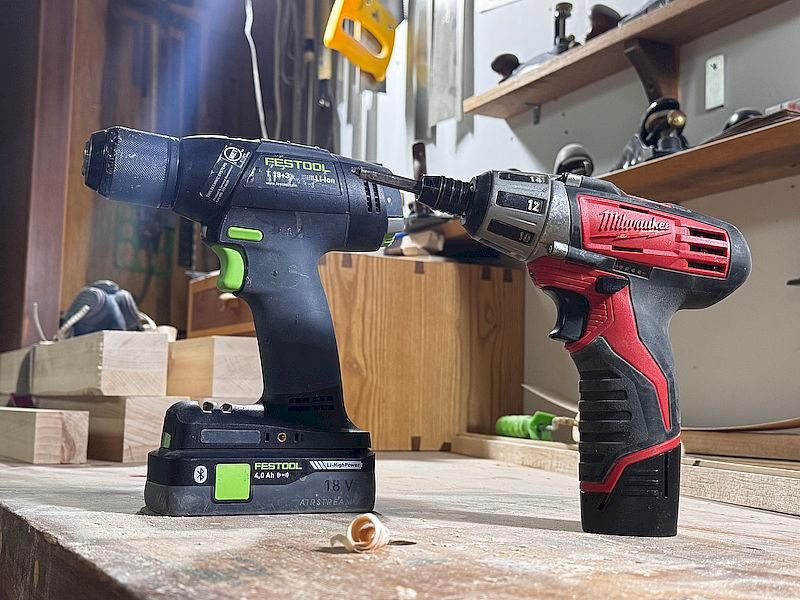
Here is my favourite drill, a 12V Milwaukee, alongside the 18V Festool drill I reach for when the going gets tough. The 12V allows me to easily fine tune the depth of a screw with an 1/8 revolution to literally any screw I use in my furniture-making workshop.




Hate them all you want, that changes nothing about their usefulness, particularly driving many fasteners in sequence (think fastening fence or deck boards, and similar repetitive tasks). I agree I wouldn’t reach for one for furniture assembly when the finesse of a regular drill makes more sense.
But I’m at a loss to understand how the editor of a magazine that has the words ‘HOME IMPROVEMENT’ in the title could come out with a statement like ‘I hate Impact Drivers’. If I were an advertiser, I’d think twice about purchasing ad space in any publication that would say that.
I agree with you on this, I personally dont use my impact driver unless I need the extra heft. I prefer to use my drill since it has the clutches on it and I do prefer my 12 volt makita over the 18 volt drill although I have one, for the reason of weight and honestly the 12 volt does everything I need.
Every tool has its limits and by design it’s use. I fully agree that for cabinet installation and furniture building a good drill is hard to beat.
When it comes to framing (and I consider deck construction a form of framing) an impact rules. When my generation 1 M18 Fuel impact started rattling a bit too much I replaced it with a M18 Surge. The hydraulic drive system is so much quieter and smoother that the clutch system of the traditional impact. I suggest you try one on a project or 2, it might tame your view of impacts.
I have only experienced the impact driver with my son. They are noisy. Drive the screw in too deep. And are not my choice for cabinet and fine furniture projects.
I like gentle purr off my battery pack drills. I like how I can set the clutch on it so it stops at the correct depth. I have two drills, exactly the same and four batteries. Always a battery charged, one in the charger and two in the drills.
I’ve enjoyed the torque and control I get from my Dewalt 20 volt impact driver, a staple in my shop for driving all sized screws for decades. likewise my Dewalt 20 volt impact drill which is great for drilling in concrete or stone, removing torqued-on hex nuts or rusted-in-place bolts or driving lag bolts/screws. With its multiple settings I find I have total control over how much impact the drill delivers or simply drilling with no impact at all through one of two speed ranges. And by standardizing on 20 volt I have multiple batteries available at all times for long jobs or in the field. Plus I can decide to use either 1.5ah or 5ah batteries depending on my application; both sizes fit all my Dewalt tooling.
Nah.
I like the impact drivers.
I have several cordless drills and three impact drivers.
For really small screws and brass of course, I use drill but mostly the impacts.
Impacts certainly have a use most probably in a shop like yours, unless you are maybe building heavy outdoor furniture. I try to always think of what job I am doing and select whatever tools are needed to get that job done. I have 12v, 18v & 20v tools. Drills and impacts in all voltages. I still sometimes need to use my Grandfather’s hand planes. He was a traveling cabinet maker for the Georgia Showcase Company. He built custom cabinets on site.
I always like your articles and seeing your projects.
I love my Milwaukee 12v drills. My electrician son arrived to effect a repair and I fell in love with his upon first use. I told him that he now knew what I needed as my next Christmas present. He listened. The 2-piece set included a 3/8″ and an impact driver. I have since added a 1/2″ hammer drill and have another that travels in our camper to raise and lower the jacks.
The impact driver has been used to remove recalcitrant screws that the others balked at. As I have 3 concrete walls in my shop it is also used to drive concrete screws into them when things need hanging. The hammer drill works, too, but the impact driver is a beast.
Like any religion, I do not judge others beliefs, so believe what you wish. Just don’t try to make me believe yours.
Happy drilling!
Rob, surely you recognize that driving a large screw, particularly with a Phillips #2 head, is much easier with an impact gun. A drill will often strip the head of the screw if the going gets tough or the drill isn’t perfectly aligned with the screw head.
An impact driver is equally helpful removing tough screws for the same reason. Mechanics use the pulse of an impact wrench to loosen rusted, frozen nuts and bolts without damaging the heads.
I agree with you about impact drivers. Most of them are too heavy. I am an average sized person but holding a heavy thing isn’t comfortable. I’m probably ancient school, I use a brace and bit for most of my screw driving. I get the control and feel of how things are going in my project. I have an adapter for screws,bolts and one for hexagon bits as slowly the tapered head shanks of braces get harder to find. Some people have carpet tunnel so using a screw driver is difficult. My wife laughs and thinks we’re in the 1800’s. She stopped when she had 15, 3 inch screws to drive. After 5 screws installed she was taking a break. I finished the rest of them with my brace. I didn’t even sweat on a hot day.
Just wondering, have you had any trouble with the milwaukee batteries? I have the same drill and have some experience with other milwaukee tools. I’ve found their batteries will suddenly fail completely. No power and unable to charge
Hi Patrick,
I have a few 12V Milwaukee drills, a few other 12V Milwaukee tools and about 7 batteries. All have worked wonderfully for about 10 years now and are still going strong.
I disagree on the impact driver.
My Milwaukee 18 volt has 4 different settings, so it will driver any screw to any depth you want. I also have the Milwaukee cabinet drill/driver which is great for cabinet work. I have used both the drill and impact separately, over the lifetime of cordless tools. I have found my impact does the service great. And the impacting noise does not kick in until the very last moment if it is needed.