[aioseo_breadcrumbs]
TIPS & HOW TO
The Difference: Rip and crosscut blades

Carl Duguay
Choosing the right saw blade for the job — whether for a table saw, bandsaw or hand saw — can make a noticeable difference in cut quality, efficiency and even safety.
Although the shape and size of a circular blade (for a table saw or mitre saw, for example) and a hand saw blade differ, the general tooth geometry is still the same.
Two of the most common types of blades are rip blades and crosscut blades. While rip and crosscut blades might look similar at first glance, their design and function are quite different; each is optimized for cutting in a specific direction relative to the wood grain. The distinctive difference between them is the design of the teeth.
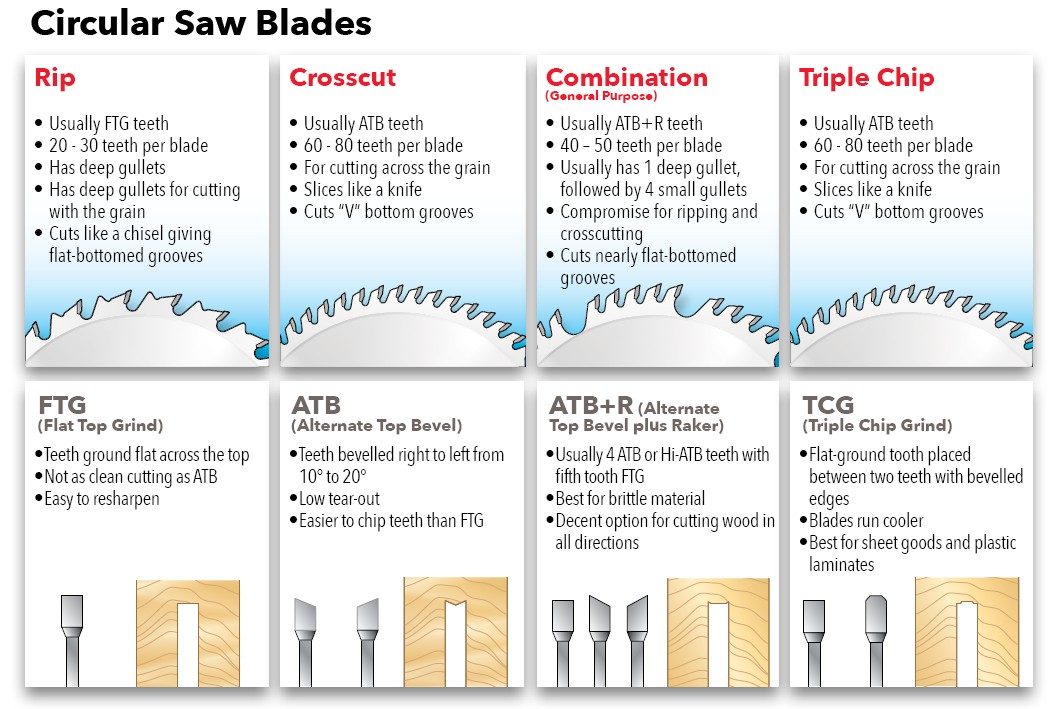
A rip blade is designed for cutting along the grain of the wood, a process known as ripping. This is typically done when you need to break down a wide board into narrower strips. The teeth on a rip blade are shaped like small chisels and usually have a flat top grind (FTG). These chisel-like teeth split the wood fibres efficiently and aggressively, making fast work of long, straight cuts. Because of this, rip blades tend to have fewer teeth — generally 10 to 30 on a 10″ table saw blade, or 4 to 9 teeth per inch (TPI) on a hand saw — allowing them to remove material quickly. Rip blades are commonly used on table saws or bandsaws when preparing stock for glue-ups, cutting boards to width or breaking down rough lumber. A rip cut hand saw is similarly used whenever you want to cut wood along the grain, such as when cutting dovetails.
On the other hand, a crosscut blade is made for cutting across the grain, for example, when you need to trim a board to final length. The teeth on a crosscut blade are sharpened to a point with alternating bevels, often referred to as an alternate top bevel (ATB). These teeth slice cleanly through the wood fibres like a series of tiny knives, leaving behind a smooth surface with minimal tear-out. Crosscut blades have more teeth than rip blades — usually 60 to 80 on a 10″ circular saw blade, or 8 to 16 TPI on a hand saw — which results in a slower, more refined cut. They’re most commonly used on mitre saws, radial arm saws, or with crosscut sleds on a table saw for tasks like sizing parts for cabinetry, trimming boards to length or cutting plywood panels cleanly.
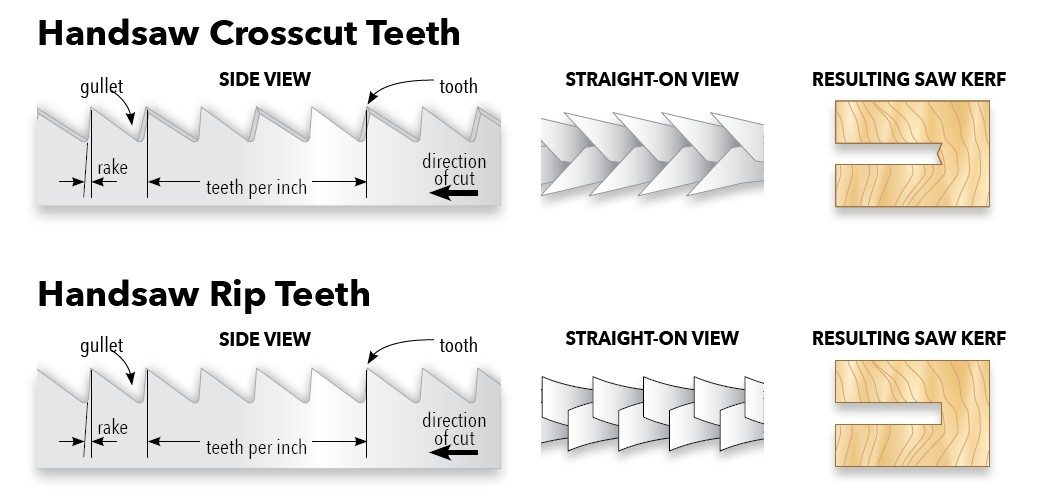
Using the wrong type of blade for a cut can lead to poor results. If you use a rip blade for crosscuts, the chisel-like teeth will tend to tear and splinter the wood fibres, leaving a ragged edge. Conversely, using a crosscut blade for ripping can overload the saw, slow down the cut and even burn the wood, as the fine teeth struggle to clear material efficiently along the grain.
For woodworkers who want versatility, combination blades are also available. These blades typically have four crosscut teeth, followed by one rip tooth in a repeating pattern. This option is more commonly available in a table saw blade, though can also be found in a hand saw. These blades feature a mix of tooth styles and are designed to handle both ripping and crosscutting reasonably well, though they don’t match the performance of task-specific blades in terms of speed or finish quality. Triple-chip (also referred to as TCG, triple chip grind) circular saw blades are also available. Their main purpose is to cleanly cut melamine, surfaces with plastic laminate applied to them and some other materials. The have a rip tooth followed by a slightly protruding rip tooth that’s been ground to 45° on both its corners, in an alternating and repeating pattern.
Understanding and using the appropriate blade for each type of cut will not only improve the quality of your work but also help extend the life of your tools and make your shop time more enjoyable and efficient.